In lane Venues & Destinations
The Room Before the Vows: How to Research and Tour Your Wedding Venue
Description
Picture the last few minutes before a ceremony. The music is playing, the guests have found their seats, and the wedding party is lined up and ready to walk. Except there is nowhere for them to wait o...
Picture the last few minutes before a ceremony. The music is playing, the guests have found their seats, and the wedding party is lined up and ready to walk. Except there is nowhere for them to wait out of sight. So the guests sit and look at the wedding party, and the wedding party stands and looks back, everyone waiting together in a slightly strange silence. It is far from the worst thing that can happen, but the decision that would have changed it was made months earlier, on a venue tour.
I once arrived at a church to photograph a ceremony and was told by the pastor that I could not take a single photo of it. The couple had no idea. Nobody had asked.
That is why I approach venue research the way I do. I am a wedding planner, so I walk every space thinking about the timeline, the logistics, and the contract. I am also a wedding photographer, so I walk it thinking about light, backgrounds, and the gallery you will hold onto for the rest of your life. Your venue is the frame for every other decision you make, and it deserves both points of view.

One Hundred Venues, Fifty Conversations, Twelve Contenders
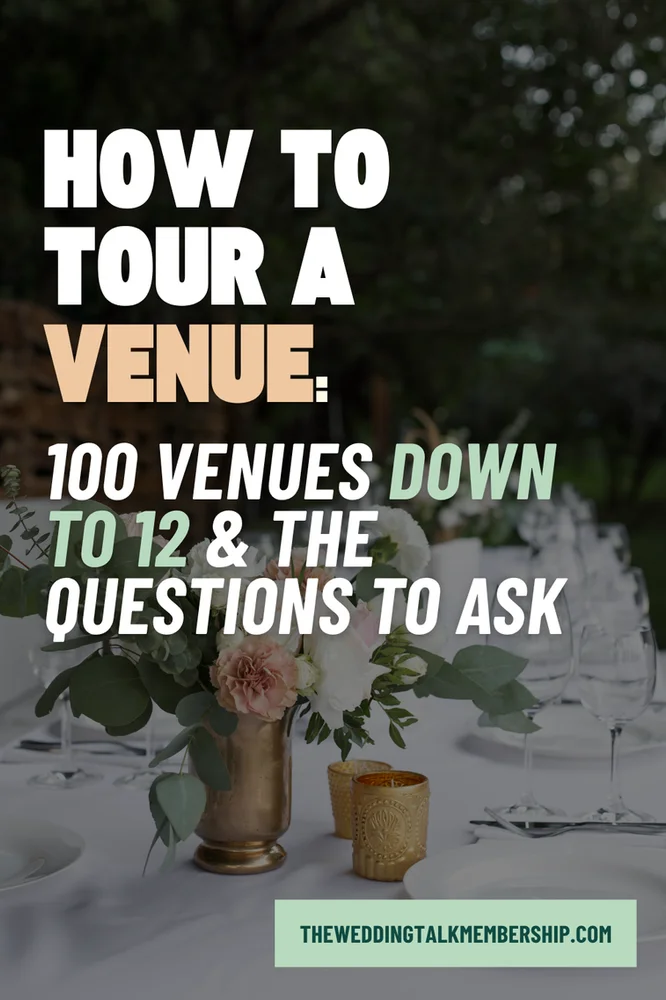
When I research venues for a client, the funnel looks like this: I start with about 100 venues, I end up talking to about 50 of them, and from there I narrow it to about 12. You do not need to look at 100 venues yourself, but the structure works at any size.
My first pass is honestly very basic. I list the venue name, the website (so I can grab it quickly), and my notes. That is it. Then I keep a folder for every venue so the email threads stay organized, because emailing gets crazy pants very fast once you are in conversation with a dozen places at once.
Once I have actually talked to everyone and have my shortlist, I build a visual comparison in Canva. For each venue I lay out three things:
Best components. What this venue does beautifully.
Things to consider. The limitations, rules, and question marks.
Budget breakdown. What it will realistically cost once everything is included.
I add a link to the venue's website on each one so I can jump back in. If you are a visual person like me who needs to see things fully hashed out, I highly recommend making something like this for yourselves.
Read the Light First
If I had to name the one thing I look at most fundamentally in a venue, it is lighting.
If a space is low and moody, my question is: how are they making it moody? Is the room being lit in an artistic, intentional way, or is it simply dark? But if you find a venue that is bright enough in the space, it almost guarantees that you are going to have amazing photos all the time. Windows are a dream.
From behind the lens: Photographers create with the light a room gives them. A bright, window-filled space gives your photographer room to work all day long, from the getting-ready shots through dinner. A dark room is not a dealbreaker, but it means the venue's lighting choices (and your own, like candlelight and uplighting) carry much more weight.
Then go find the getting-ready space, because it is always the last thing venues think about. These rooms can be surprisingly plain, and that matters more than it seems. You take so many images in the morning, and if every one of them is surrounded by a space that does not feel like you, that may upset you when you open your gallery later. If the venue's getting-ready room falls flat, it is completely reasonable to get ready somewhere nicer nearby and arrive dressed for the day. That is a decision with tradeoffs (transportation, timing, one more location to coordinate), but for your photos, it can be worth it.
The planner's note: While you are walking the space, look for where the wedding party will hide before the ceremony. Even at the very beginning of picking a venue, I am looking for that spot. You do not need to disappear for a full hour (most guests arrive within the last 30 minutes, and if anyone comes an hour early, it is usually a grandpa), but you do want somewhere comfortable to wait and then enter from a hidden position.

Book the Room Before You Fall for the Menu
Personally, I love when catering comes with the venue. It is a huge thing I look for, because it simplifies so much. But included catering is also where many couples hit their first limitation. If a venue only does one style of food and your families care deeply about another, that is your first hiccup, and you want to find it before you sign.
Here is my honest advice: if you do not have a venue yet, do not start dabbling in caterers. I have watched a couple fall in love with a food truck, book the venue of their dreams, and then learn the venue did not allow food trucks. If you have a serious catering need, make sure your venue is comfortable with it before you sign the dotted line.
When you tour, ask:
What catering comes with the venue?
How much flexibility do we have with the menu?
If you cannot meet our food needs, can we bring in a separate vendor?
If we bring in outside food, will your staff help serve it?
Two numbers to keep in your back pocket. Catering and bar almost always carry a service fee, typically around 22%. Some venues are very upfront about it and some reveal it later, so it is a safe bet to set that 22% aside regardless. And look for cake cutting fees. A $2 plate fee sounds small until you multiply it by your guest count.
If you do bring in an outside caterer and they have never worked your venue before, I get a little nervous. Ask them to tour the space with you before the wedding. There are always random little things, like the time there was no water spigot for the caterers to fill their hot pots. Ask me how I know that. And if a venue has a preferred vendor list, I would not read that as the venue being restrictive. Most of the time, a vendor is on that list because they do a good job in that space.
The Contract That Holds Everything
Your venue contract is the most important contract you will sign in the entire process, because that space holds the entire day.
Above everything else, get your start and end times clear in writing. Your whole timeline is built on them, along with every vendor arrival time.
The planner's note: If your venue has a hard out at 10, I tell vendors the hard stop is 10, but I set our planned end time at 9:30. Those 30 minutes give everyone room to wrap up gracefully instead of racing the clock.
A few more contract conversations worth having on a tour:
Setup time. How early can you get in? Couples forget how long it takes to set up decor, and you cannot load every table with every possible piece in a two-hour window. If you need more time, there may be a fee to get in earlier, and that is where the sneaky budget things happen.
Rehearsal. Is a rehearsal included? For how long, on what day, and in what time slot? Is there a wedding the night before? Will the ceremony space be set up, or will it be bare?
House rules. Candle and open flame policies, aisle petals, outside decor. If your ceremony is in a church, ask about photography rules early, so you never have the surprise I did.
Guest count. If your numbers might change, ask whether that flexibility can be written in. I once helped a couple add flexible guest count language mid-planning when their list dropped from 100 to 50. Jumping from one contract to another could have meant serious fees.
Venues that have been around a long time often use the same contract they have had forever, missing the details you care about. If your plans change, ask whether the contract can be updated.
Beyond the Venue Gates: Dates, Hotels, and Parking
The best venue in the world still lives in a town with its own calendar. Before you commit to a date, check that it is not a college visit day, a holiday, or a local festival weekend. Those immediately make everything more expensive and make hotels much harder to find.
Look at location the same way your guests will. Is the venue close to hotels? Is there adequate parking capacity, and does the layout make sense? A guest who parks and then has no idea where to walk is a guest who arrives late through no fault of their own.
Once your venue is booked, room blocks come next, and I like to keep them low pressure:
Call the hotel that is best and closest to your venue and ask for the salesperson. Going straight to them is almost always easier than a third-party service, which is only really worth it if your venue is surrounded by hotels (and most people do not get that lucky).
Start with about 10 rooms. Then ask how flexible the block is, when you can add rooms, and when it is too late before you are charged. In my experience, many hotels have a hard deadline around two weeks before the wedding.
One block is enough. Instead of managing two, list a few alternative hotels at low, middle, and high price points. Your guests are adults, and they will be able to look them up.
If you travel in for a planning weekend, stay at your own room-block hotel. You will know firsthand what your guests are walking into, and you start that relationship on good footing.

Your Venue Tour, at a Glance
Bring a written list of questions to every tour. When you are making such a big decision, your brain can only hold so much while also experiencing the space in front of you. Having something to refer back to means you will not miss anything.
What to check | Why it matters | Ask the venue |
Lighting | Bright spaces almost guarantee great photos | If the space is low light, how is it lit? |
Getting-ready space | Your morning photos live here | Where would we get ready? |
Wedding party hideout | Lets you enter from a hidden position | Where can we wait before the ceremony? |
Catering | Your first possible limitation | What is included, and can we bring in outside food? |
Fees | Service charges add up | What is the service fee? Is there a cake cutting fee? |
Start and end times | Your timeline depends on them | What are our exact access and end times? |
Setup window | Limits how elaborate your design can be | How early can we get in, and is there a fee? |
Rehearsal | Practice changes the whole ceremony | Is it included, when, and will the space be set? |
Hotels and parking | Guest experience starts in the car | How far are hotels? How much parking is there? |
Keeping It All in One Place
If you are a member of The Wedding Talk Membership, the Vendor Tracker is built for exactly this stage. It brings together my Vendor Interview Workbook and Vendor Research Tracker, so you can log every venue you research, keep your notes in one place, and compare your favorites using one shared set of ratings. In your Wedding Planning Roadmap, booking your venue is the moment the Foundation phase wraps up, and it is a wonderful milestone to celebrate.
If you are not a member, well... it's for DIY couples that are planning on their own but don't want to miss a thing... and I think you should enroll. We meet live every week too, join me for the next call and we'll work on your wedding together!
The Right Room Will Feel Obvious
Keep your list simple, keep your emails organized, and walk every space for both the light and the logistics. When you lay your top contenders side by side, the right room tends to make itself known.
Happy Planning!
Lynea